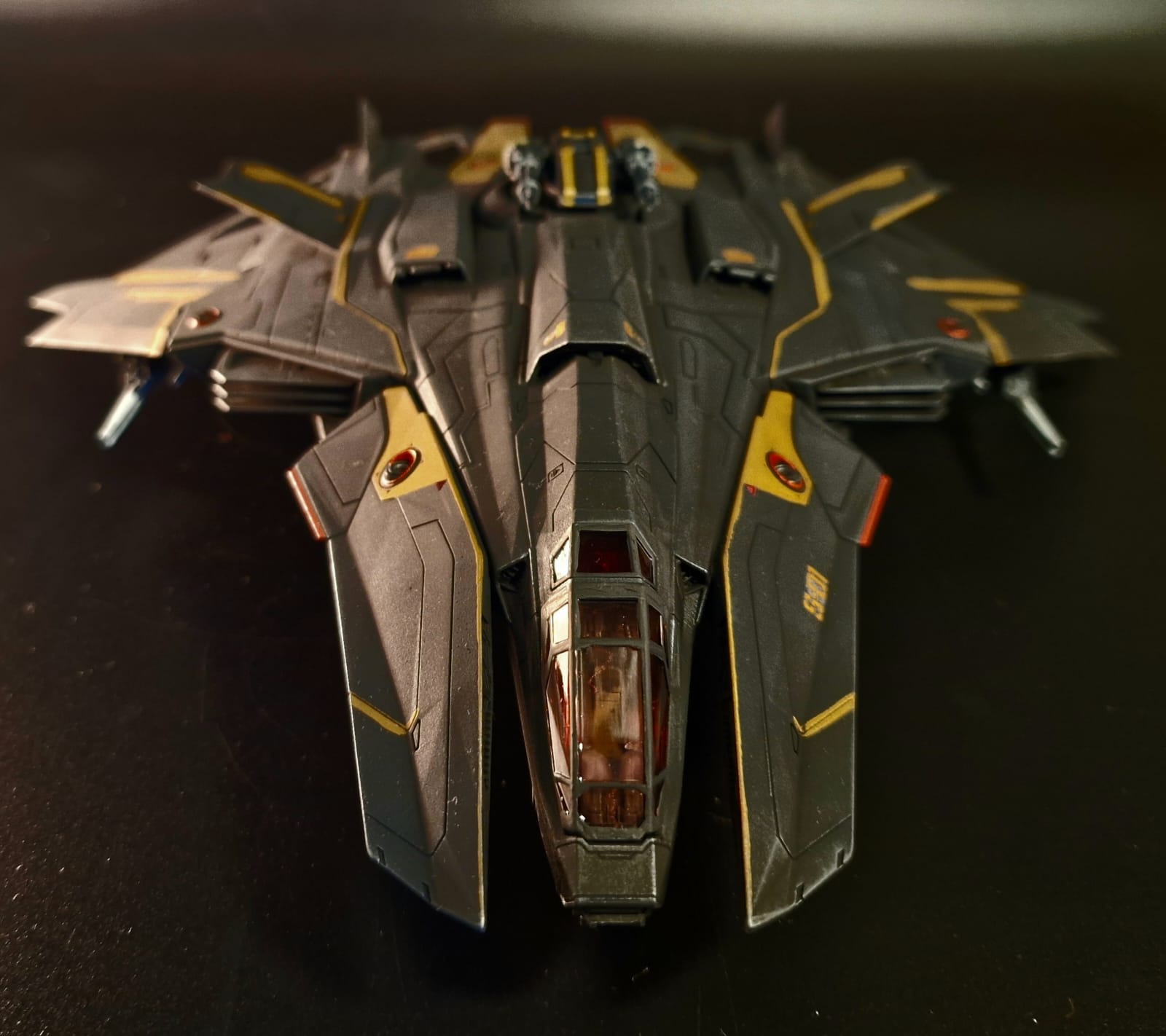
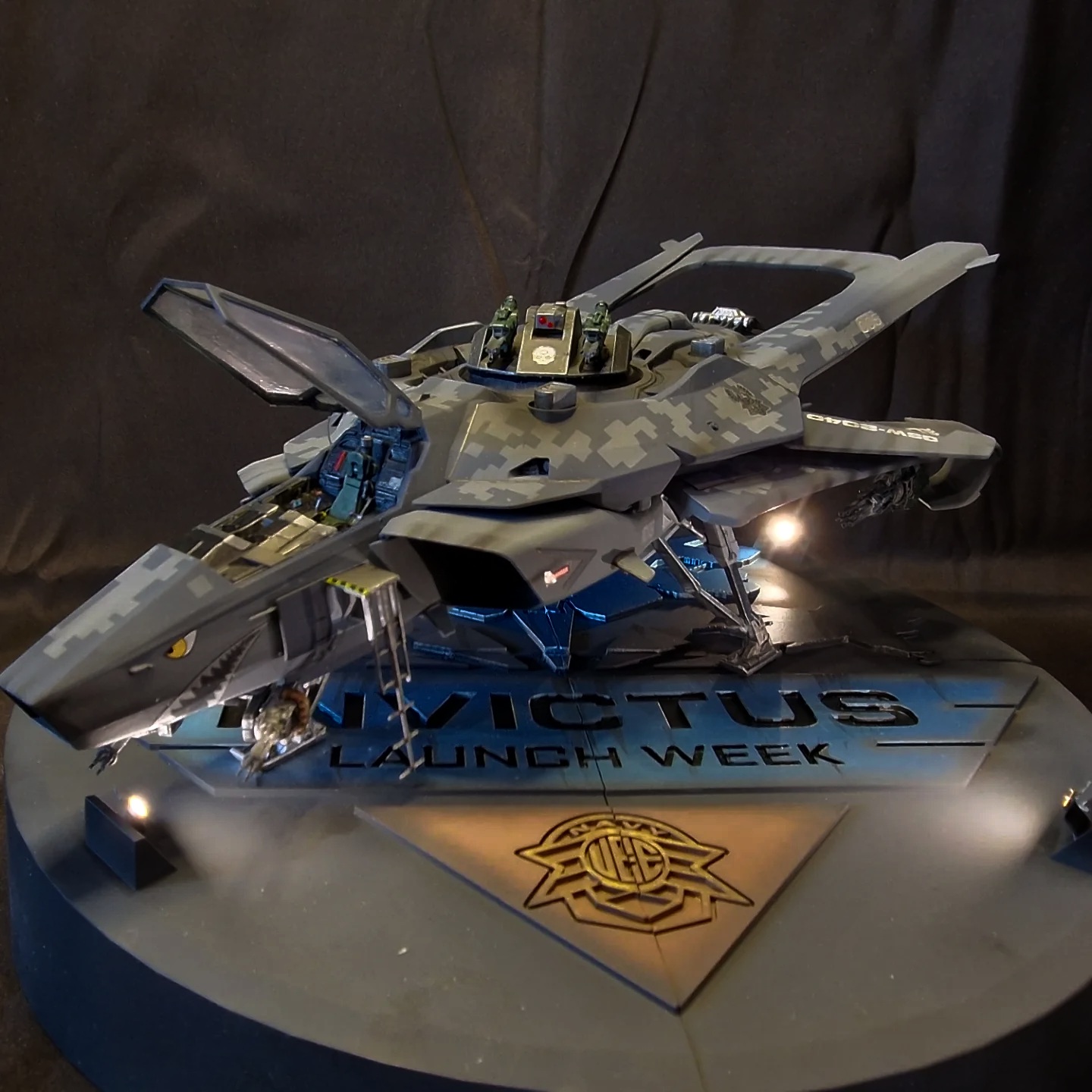
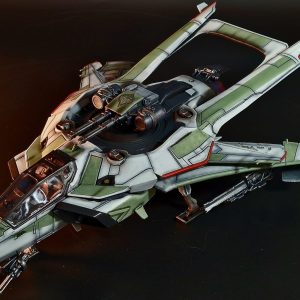
The Anvil F8C Lightning brings the outline of a naval space-superiority fighter into the civilian world of Star Citizen. It is a single-seat heavy fighter with a wide, purposeful airframe and an array of forward-facing weapons. Polacus Workshop’s miniature records that design as a physical model, with a photograph and a workshop video offering different views of its shape.
A naval fighter and its civilian counterpart
The Lightning belongs to a family associated with the United Empire of Earth Navy. The military F8A is a frontline fighter used in the defense against the Vanduul, while the F8C represents the version offered to civilian pilots. That relationship gives the F8C much of its identity: its name and overall form connect it to a ship associated with naval service, even when the person at the controls is operating outside the Navy.
Anvil offered the F8C in limited numbers to mark the military Lightning’s debut. The distinction between the two versions matters in the setting. The F8A is the service model of an organized military force, while the F8C places a related design in the hands of individual owners. The resulting ship appeals to pilots who want a heavy fighter that carries the visual presence and reputation of the Lightning family.
A ship built for space superiority
Space superiority describes the role around which the fighter is built. A pilot must be able to engage hostile spacecraft and defend a section of space, whether that means protecting a formation or responding to an approaching threat. The Lightning’s heavy-fighter classification reflects its emphasis on combat capability. It is a spacecraft organized around the pilot and the systems needed for a fight, rather than a transport built to carry passengers or freight.
The arrangement of the airframe makes that purpose visible. The cockpit sits within a broad structure that gives the Lightning a substantial frontal profile. Gun mounts and a turret form part of its combat layout, while the wing assemblies extend the shape outward on either side. From above, the central body and the outer sections read as a connected whole. From the side, the height of the cockpit and the layers of the hull become easier to distinguish.
The F8C is also part of a wider Anvil Aerospace tradition in Star Citizen. Anvil’s catalog includes the Hornet family, another line of combat spacecraft closely connected to military service. The Lightning has its own silhouette and heavy-fighter role, but the two families share a place in the fictional manufacturer’s association with defensive and military craft. Looking at the workshop’s Hornet models alongside the F8C makes the differences in their proportions especially apparent.
The Lightning and the Vanduul conflict
The Vanduul form an important part of the context for the military Lightning. The conflict between the Vanduul and the UEE is a recurring element of Star Citizen’s setting, shaping the stories told about naval operations, frontier defense and the spacecraft assigned to protect human space. The F8A’s connection to those defenses adds weight to the Lightning name. The civilian F8C carries that association into a different kind of ownership.
The workshop model
For a model maker, the Lightning offers a combination of broad surfaces and smaller structural details. The large forms establish the fighter’s unmistakable profile, while the divisions between panels, cockpit and weapon positions provide features to follow at close range. The physical piece gives those shapes a fixed scale and invites the viewer to study them from angles that might pass quickly during flight.
The gallery photograph introduces the Polacus Workshop build, and the accompanying video provides another look at the same physical model. Together they document the interpretation of Anvil’s fighter in miniature. Details of the fictional spacecraft describe the Star Citizen design, while the images show the particular workshop piece presented on this page.
Workshop video